















Low pool pH can cause eye and skin irritation, damage pool surfaces, and corrode equipment over time.
Fortunately, correcting low pH is usually straightforward. One of the most common and cost effective solutions is baking soda, also known as sodium bicarbonate. Many pool owners use it as a simple DIY treatment to restore water balance and improve overall pool health.
Before investing in expensive treatments or troubleshooting cloudy water, always start by checking and balancing your pool chemistry. Proper water balance is the foundation of a clean, safe, and inviting swimming pool.
Can Baking Soda Be Used to Increase Pool pH?
Yes. Baking soda is widely used by pool owners to help correct low pH and low alkalinity. In fact, it is considered one of the most reliable household products for maintaining balanced pool water.
Baking soda primarily increases Total Alkalinity (TA), which in turn helps stabilize pH levels. When alkalinity is too low, pH levels can fluctuate dramatically, a problem often referred to as "pH bounce."
By increasing alkalinity, baking soda creates a buffer that helps prevent sudden pH swings and keeps water chemistry more stable over time.
While products labeled as "pH increaser" are typically made from sodium carbonate (soda ash), baking soda remains a popular choice when both alkalinity and pH need improvement.
Why Does Baking Soda Work?
To simplify the chemistry, baking soda is an alkaline substance with a natural pH of roughly 8. When introduced to an acidic environment with a pH below 7.2, it neutralizes the excess acid, shifting the baseline closer to the ideal pool water range of 7.4 to 7.6.

A standard pool test strip chart indicating ideal chemical zones. Source: Clorox Pool
The primary benefit of using sodium bicarbonate lies in its management of Total Alkalinity. Total Alkalinity acts as a protective shield for your pH level. Without sufficient alkalinity, even a minor external factor like heavy rainfall or heavy swimmer usage can cause your pH levels to rapidly spike or plummet. By reinforcing your alkalinity, baking soda stabilizes your water balance over the long term.
How Much Baking Soda Do You Need?
The standard rule of thumb for pool chemistry states that 1.5 pounds of baking soda per 10,000 gallons of water will raise your Total Alkalinity by approximately 10 parts per million (ppm). Because raising alkalinity inherently pulls pH upward, this dosage serves as your baseline calculation.
However, water chemistry requires precision. You must test your water first to determine your exact starting numbers rather than guessing.
The table below outlines standard dosage requirements based on common pool volumes when your Total Alkalinity needs a target increase:
|
Pool Volume (Gallons) |
To Raise Alkalinity by 10 ppm |
To Raise Alkalinity by 20 ppm |
To Raise Alkalinity by 30 ppm |
|
5,000 |
0.75 lbs |
1.5 lbs |
2.25 lbs |
|
10,000 |
1.5 lbs |
3.0 lbs |
4.5 lbs |
|
15,000 |
2.25 lbs |
4.5 lbs |
6.75 lbs |
|
20,000 |
3.0 lbs |
6.0 lbs |
9.0 lbs |
|
25,000 |
3.75 lbs |
7.5 lbs |
11.25 lbs |
Important Caveat: If your pH is exceptionally low (below 7.0) but your Total Alkalinity is already within the ideal zone of 80 to 120 ppm, adding massive quantities of baking soda will drive your alkalinity too high, leading to cloudy water and scale buildup. In that specific scenario, a dedicated pH increaser like soda ash (sodium carbonate) may be required instead.
How to Effectively Use Baking Soda to Adjust Pool pH
Follow this precise sequence to safely apply baking soda to your swimming pool:
1. Test the Water: Prerequisite
Use a reliable liquid test kit or high quality test strips to confirm your current pH and Total Alkalinity levels. Ensure your target goals are a pH of 7.4 to 7.6 and an alkalinity of 80 to 120 ppm.
2. Calculate Your Dosage: Planning
Determine your pool volume in gallons. Cross reference your volume with your test results using the dosage chart above to calculate the exact weight of baking soda required. Avoid adding more than 2.5 pounds per 10,000 gallons at one single time.
3. Pre-Dissolve the Powder: Preparation
Ensure your pool pump and filtration system are turned on and running completely. Fill a clean 5 gallon bucket with pool water, then measure and pour your calculated dose of baking soda into the bucket. Stir thoroughly until the powder completely dissolves into a clear liquid.
4. Distribute around the Perimeter: Application
Walk slowly around the deep end perimeter of your pool, pouring the dissolved mixture gradually into the water. Avoid dumping the entire bucket into a single spot, as concentrated pockets can cause localized cloudiness or chemical settling on the pool floor.
5. Circulate and Retest: Execution
Keep your pool pump running continuously for at least 4 to 6 hours after application. This ensures the chemical distributes uniformly across the entire body of water. Once this circulation window has passed, retest your water chemistry before allowing swimmers back in or making further adjustments.
How Long Should You Wait After Adding Baking Soda to a Pool?
Adding baking soda to your pool is only the first step. Giving the water enough time to circulate ensures the chemical is evenly distributed and allows pH and alkalinity levels to stabilize before retesting.
Typical Waiting Time
- Initial Circulation (4 to 6 Hours): Your pool pump needs to run continuously for a minimum of 4 to 6 hours to distribute the sodium bicarbonate evenly through the entire body of water. During this window, the physical mixing occurs.
- Full Stabilization (24 Hours): While the bulk of the baking soda mixes within the first few hours, the chemical reactions that stabilize the Total Alkalinity and balance the pH can take up to 24 hours to reach a complete equilibrium.
When to Retest
- First Test (After 6 Hours): You can perform your first chemical check 6 hours after application. This preliminary reading will indicate whether your pH and alkalinity are moving in the right direction or if you under-calculated your initial dose.
- Final Confirmation (After 24 Hours): Always wait a full day before adding any further corrective chemicals. Performing a final confirmation test at the 24 hour mark ensures you are tracking stable, permanent levels rather than a temporary chemical spike.
Can You Swim Right Away?
Generally, it is best to stay out of the water for at least 4 to 6 hours after adding baking soda. While baking soda is completely non-toxic and skin-safe, swimming too soon can disrupt the uniform distribution of the chemical before it has dissolved completely throughout the pool.
You can safely reopen the pool once the chemicals are fully dispersed by the filtration system. Before anyone enters the water, always run a quick test to verify that the pH sits comfortably within the safe swimming range of 7.2 to 7.8.
After Balancing pH, Let Your Pool Cleaner Do the Rest
Balancing your pool's pH helps create healthy water, but it doesn't remove leaves, dirt, algae, and other debris that can affect water quality. Regular cleaning is essential to prevent contaminants from consuming sanitizers and making pool maintenance more difficult.
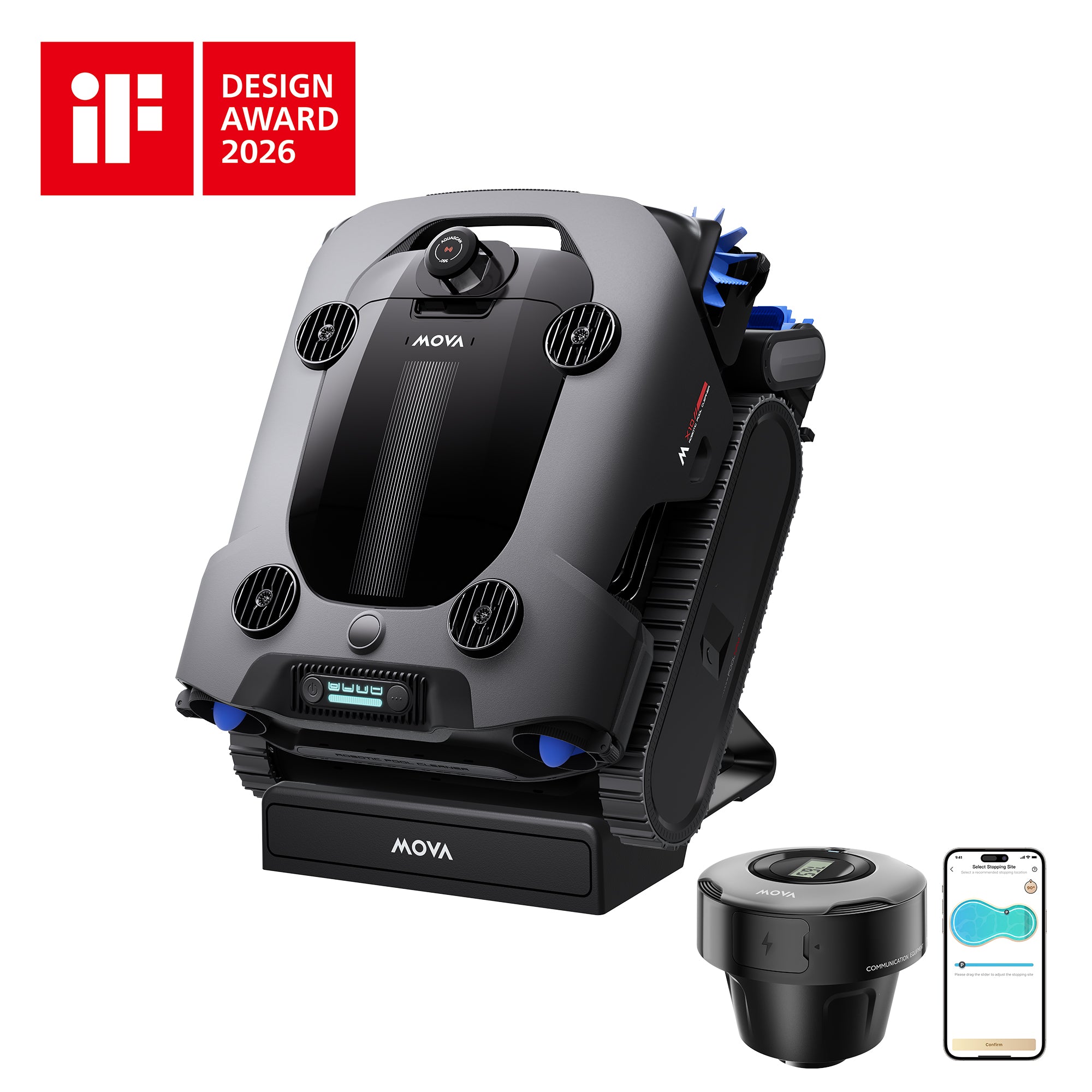
Once your water chemistry is balanced, a robotic pool cleaner can help keep your pool clear with minimal effort. The MOVA Diver A10 Robotic Pool Cleaner combines 6,000 GPH suction power with AI powered EdgePulse™ technology to efficiently clean floors, walls, and edges throughout the pool.
Its 3.5L large capacity filtration system captures both fine particles and larger debris, helping reduce buildup that can impact water clarity and chemical effectiveness. With consistent cleaning and balanced water chemistry working together, maintaining a crystal clear pool becomes much easier.
Conclusion
Maintaining proper pool pH is not a one time task. Consistent monitoring and gradual adjustments are the key to keeping water comfortable, protecting equipment, and extending the life of your pool.
For the best results, combine routine water testing and chemical balancing with regular debris removal. A maintenance strategy that includes both proper chemistry and automated cleaning can significantly reduce the time and effort required to keep your pool in top condition throughout the swimming season.
FAQs
Can baking soda raise pool pH without raising alkalinity?
No, it is chemically impossible for baking soda to raise your pH without also increasing your Total Alkalinity. Because sodium bicarbonate is primarily an alkalinity buffer, it will always increase your alkalinity levels first, which subsequently coaxes the pH level upward. If you need to raise your pH exclusively because your alkalinity is already exceptionally high, you should use soda ash or a specialized commercial pH increaser instead.
How much baking soda raises pH by 0.2?
Because baking soda targets alkalinity directly and pH indirectly, there is no single fixed dose that guarantees a flat 0.2 pH increase. The exact amount depends entirely on your pool volume and your current Total Alkalinity level. As a general starting point for a pool with a stable alkalinity baseline, adding roughly 1 pound of baking soda per 10,000 gallons of water will typically nudge your pH upward by approximately 0.2 units.
Can I add baking soda directly to the pool?
While you can technically broadcast dry baking soda powder directly across the surface of the pool, it is highly recommended to pre dissolve it in a bucket of pool water first. Dumping dry baking soda directly into the pool can cause the powder to settle in thick clumps on the floor or create temporary cloudiness that takes much longer to clear. Pre dissolving ensures immediate, uniform distribution through your filtration system.
Is baking soda the same as pool alkalinity increaser?
Yes, they are the exact same chemical compound. Most commercial "Alkalinity Increaser" products sold at pool supply stores consist of 100% sodium bicarbonate. Buying pure, food grade baking soda in bulk packages is often exactly the same as buying the branded pool store equivalent, though typically at a much lower cost.
What happens if I add too much baking soda?
Adding an excessive amount of baking soda will drive your Total Alkalinity well past the ideal 120 ppm ceiling. This results in highly alkaline water, which causes chronic water cloudiness, clogged filters, reduced chlorine effectiveness, and rough calcium scale buildup along your pool walls and internal equipment components. If your alkalinity rises too high, you will need to use muriatic acid to bring the levels back down into balance.